The Ronson New Yorker Table Lighter was one of the earliest automatic table models manufactured by Art Metal Works (AMW) in Newark, New Jersey, USA. The design of the lighter was patented by the United States Patent Office in 1929 (patent no. 80,011). This wick lighter was designed by the founder of AMW Louis V. Aronson.
ASR, Colibri, Dunhill, Dupont, Evans, Negbaur, MTC, Rolstar, Ronson, Rowenta, Zippo and many others...
Price guide included! You will also find books, catalogs, patents and magazine advertisements on lighters!
Showing posts with label patents. Show all posts
Monday, September 15, 2014
Friday, July 11, 2014
Patent: Ronson De-Light Superba Table Lighter, 1929
The Ronson Superba Table Lighter was one of the earliest automatic
table models manufactured by Art Metal Works (AMW) in Newark, New
Jersey, USA. The design of the lighter was patented by the United States
Patent Office in 1929 (patent no. 80,214). This wick lighter was
designed by the founder of AMW Louis V. Aronson.
Saturday, March 22, 2014
Patent: Ronson Banjo Cigar Lighter, 1928
The first automatic pocket cigar/cigarette lighter Ronson Banjo was invented by Louise V. Aronson the assigner to Art Metal Works, Inc., Newark, N. J. It was patented on 12th June 1928. The patent 1,673,727 protected the lighter mechanism till 1933 when the patent was reissued as patent no. 19,023 on 12th December 1933.
Friday, January 3, 2014
Patent: Josef Kluss / Capitol Lighter, 1925
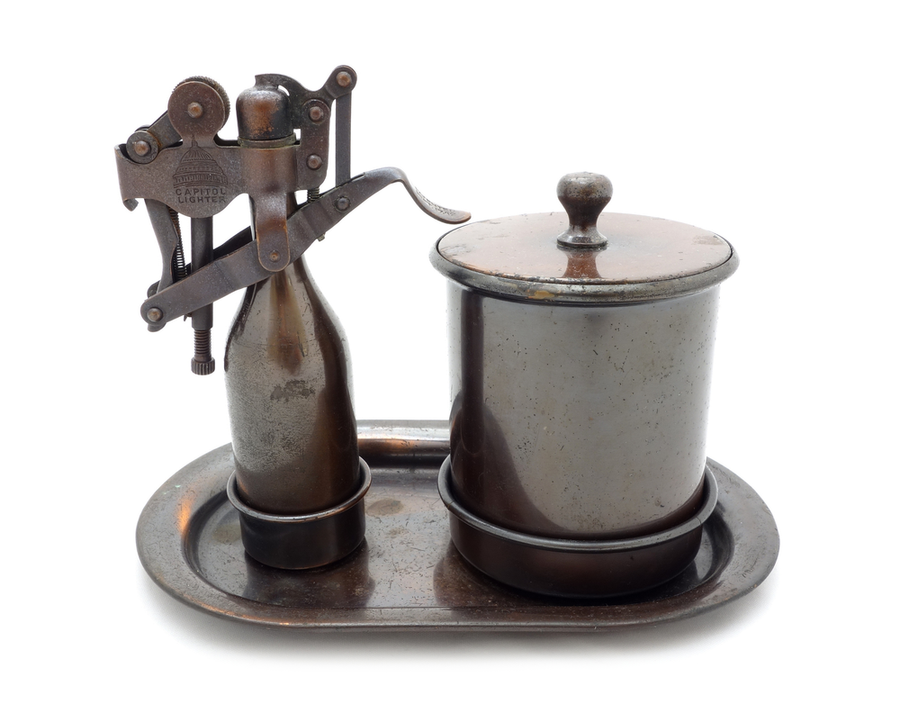
The pyrophoric lighter designed by Josef Kluss in Wien and patented in Austria in 1925 was used by Steele & Johnson of Waterbury to produce the Capitol Lighter which was a success in the US.
Capitol Lighter, Steele & Johnson of Waterbury, 1927
The Capitol Lighter was manufactured between 1927 and 1931 by Steele and Johnson in Waterbury (Connecticut) in the United States of America. The company was founded in Waterbury in 1851 and manufactured brass and other metal goods. The firm opened a New York shop in 1865 and ceased operation in 1933. This unusual brass/bronze table lighter features a mechanical snap up levered mechanism. The mechanism as well the design of the lighter were invented and patented on the 10th of March 1925 (patent no. AT99438) by Josef Kluss of Vienna in Austria. The fact that Steele & Johnson Mfg. Co. used the patent filled by George S. Eldred on 17th September 1912 in the USA (patent no. US1038735) is unfounded as it features a absolutely different mechanism (semi-automatic).
This automatic petrol lighter is one of the most desired lighters by collectors because of the fairly complicated and interesting mechanism. The Capitol Lighter was manufactured in many different configurations (lighter with ashtray – both table and floor, lighter with a tray and cigarette holder etc.). Also the choice of finishes was quite impressive: plain brass, bronze, nickel plate and painted in three basic colors: red, green and yellow which was the most common one).
There are two main version of the Capitol Lighter. The earlier one manufactured between 1927–1928 is a direct copy of the Josef Kluss design in which the thumb lever of the lighter is straight and marked PATENT APL FOR. The second version (see pictures) has a curved thumb lever and was marked PATENTED SEPT. 17, '12. For filling the lighter mechanism is removed from the top of the bottle. On the earlier version of the Capitol lighter a circle label on the bottom says:
Matchless Utilities Co.
690 8. Ave. New York
Classic Gas & Cigar Lighters
Telephone Lackwanna 8855
690 8. Ave. New York
Classic Gas & Cigar Lighters
Telephone Lackwanna 8855
and the younger version:
Steele & Johnson Mfg. Co. Waterbury Conn.
New York Office 290 Madison Ave.
The lighter was also manufactured for Gerlach Barklow Co. which was one of the largest calendar and advertising companies in America. It was marked "G.B. Co. Joliet ILL." rather then "Capitol Lighter".
Type: petrol (wick) lighterScarcity: uncommon to very rare (depends on version)
Value for good–mint condition: $100.00–400.00 (approx €75.00–300.00)
Weight of the lighter alone: 90 grams (0.2 pound)
Dimensions:
- height: 11.3 cm (4.4")
- width: 7.3 cm (2.9")
- depth: 2.8 cm (1.1")
Wednesday, December 18, 2013
Patent: Ronson Touch-Tip Lighter Mechanism, 1935
The flame producing mechanism of the famous Ronson Touch-Tip Table Lighter was patented in 1935 by Louis V. Aronson. The no. of the patent is 1,986,754. The graphics of the anatomy of the lighter are based on the Ronson Touch-Tip Oval which production started in 1937 in the US (here is an magazine advertisement with the "Oval"). The most popular of the touch-tip range was though the Ronson Octette.
Saturday, October 5, 2013
Patent: Alfred Dunhill, Roman Lamp Lighter, 1937
Saturday, September 15, 2012
Patent: Ritepoint Liter, Table Model, 1949
Sylvester G. Lipic was the inventor as well the designer of the whole Ritepoint Lighters range. He was also the first president of Ritepoint Co. of St. Louis, Mo. The below patented design was introduced in 1949 as the Ritepoint Roman Classic which was available in four colors. It was the first table lighter with a transparent fuel reservoir (today known as the vu-lighter) which was a lucrative invention as it was widely used in the advertising sector.
Tuesday, August 21, 2012
"Silent Flame" Table Lighter Operating Instruction
The improved "Silent Flame" lighter mechanism was invented and patented by Irving Florman in 1935 in the United States of America (U.S. Pat. 2,020,142). The invention was known as the electric cigar lighter "of the type wherein a wick is ignited through the heat of an electrical resistance element". Below an instruction on how to care and use such lighter. It applies to all Silent Flame Lighters made by PARKER and Dunhill.
To Fill Lighter: Turn knob at top of lighting stick to left to remove. Fill stick to top with any good lighter fluid. Do not use gasoline or kerosene. Replace knob at top of stick.
To Light: Rest the lightning stick upon the metal railing around the top of the lighter, at the same time touch the protruding point of the lightning stick against the metal figure in the center of the lighter so as to make a contact. Do not scratch any part of the lightning stick against any other part of the lighter.
To Exchange Batteries: The lighter operates on two batteries. Any standard dry cell of the correct size will do. At the bottom of lighter is a screw. Turn this screw to remove the base. This exposes two cells, one is in an up and one is a down position, according to markings. Replace with two fresh batteries and be sure that they are put in the same up and down position at last ones and that they are firmly held in the metal clips.
Wednesday, November 23, 2011
Patent: Ronson Touch-Tip Pyrophoric Lighter, 1935
Patented Oct. 22, 1935
United States Patent Office
Patent no. 97,247
Patent no. 97,247
Design for a Pyrophoric Lighter
by Louis V. Aronson, Newark, N.J.,
assignor to Art Metal Works, Inc., a corporation of New Jersey
Application August 2, 1935, Serial No. 57,914
Figure 1 is a plan view of the pyrophoric lighter showing the new design (see: Ronson Octette)
Figure 2 is a front elevation view of the pyrophoric lighter; and
Figure 3 is a side elevation view of said pyrophoric lighter.
Sunday, May 15, 2011
Evans Table Lighters US Patents, 1949-1950
Below three interesting Evans Case Co. (North Attleboro, Massachusetts) US patents from the 1949 and 1950.
Monday, September 6, 2010
Ronson Tablelighter Banjo, 1927
The Ronson "Tablelighter" came in two versions that can be distinguished by the applied lighter fitment: Banjo and De-Light. The older version (Banjo fitment) of the Ronson "Tablelighter" also called Ronson Banjo Table Lighter was manufactured between 1927 and 1928 in Newark, New Jersey, USA. It was one of the earliest tabletop automatic lighter in the world.
The lighter was made of brass and silver plated. The front and rear panel were covered with snake and Marocco leather. Some of the examples were left without covering.
The casing of the Banjo Lighter was designed by L.V. Aronson and patented on the 17th May 1927 (filled for patent on 2nd February, 1927). The illustration below shows a side elevation of the lighter and an edge view. It comes from the granted patent no. 72,658.
The bottom is padded with green felt. The lighter is marked on the snuffer:
as well on the fuel screw on the bottom:
The bottom is padded with green felt. The lighter is marked on the snuffer:
RONSON LIGHTER
P'T'D DEC, 31,1918
OTHER PAT'S P'D'G
P'T'D DEC, 31,1918
OTHER PAT'S P'D'G
as well on the fuel screw on the bottom:
RONSON LIGHTER
PAT. NO 72,658 MAY 17,1927
Type: petrol (wick) lighter
Scarcity: very rare
Value for very good–mint condition: 1 412 zł–600.00 (approx 1 212 zł–450.00)
Weight: 150 grams (0.33 pounds)
Dimensions:
- height: 12.3 cm (4.8")
- width: 6.5 cm (2.6")
- depth: 3.4 cm (1.3")
Tuesday, July 20, 2010
Tuesday, April 13, 2010
Cigarette lighter patents
A big part of the vintage lighters was patented. The most significant number of patents for cigarette lighters was filled in the United States of America, German, England, France and Canada. Next to catalogs and advertisements patents are a good reference for lighters collectors. In most cases the access to patent bases is free. Below an example of a patent documentation for the Zippo Table Lighter from the 1956 consisting of five pages.
Subscribe to:
Posts (Atom)