ASR, Colibri, Dunhill, Dupont, Evans, Negbaur, MTC, Rolstar, Ronson, Rowenta, Zippo and many others... Price guide included! You will also find books, catalogs, patents and magazine advertisements on lighters!
The Ronson "Ronde-Light" was one of the earliest automatic table lighters made by Art Metal Works Inc.
in Newark (New Jersey) USA. It was manufactured between 1929 and 1932. It was sold as lighter and paper weight as it was quite massive.
The lighter is shaped as a ball with plain chrome plated surface. The lighter insert itself is marked:
RONSON RONDE-LIGHT
U.S. PATS.
1290011-1673727,
OTHER U.S. & FOREIGN PAT'S PDG.
ART METAL WORKS INC.
NEWARK, N.J.
Type: petrol (wick) lighter
Scarcity: very rare
Value for good–mint condition (extremly rare in this condition): $150–300.00 (approx. €125–250.00)
A black and white full page magazine advertisement published in the USA in 1928. It features the De-Light lighter series made by Art Metal Works, Inc (Newark, New Jersey, USA). It is advertised with words like: "The World's greatest lighter", "A flip and it's lit. Release and it's out!" and "The gift of gifts".
A black&white magazine advertisement published in The Saturday Magazine on November 1929. It depicts the Ronson De-Light Series including the table lighter Ronson Tabourette.
The Thorens Portor "Lady" Table/Desk Lighter was manufactured in Switzerland in 1928/1929. The wick lighter insert is a Thorens semi-automatic 'single claw' model that was manufactured between 1918 and 1935. It is made of brass and gold plated; stamped:
GOLD PLATED
MADE OF SWITZERLAND
B L
and G T on the top lid
The discreet "BL" (fr. Briquet de Luxe, eng. luxury lighter) indicates that the lighter was intended to be sold in France as it is a French tax mark. The mark was introduced in 1926 and applied only on luxury lighters like Quercia, Lancel and Thorens.
The column shaped base of the lighter and the Art Deco nude lady are made of brass. Both have an antique finish applied on. No monogram shields present and no marks on the bottom of the base. More info about the lighter and the GT stamp are welcome!
Type: petrol (wick) lighter
Scarcity: very rare
Value for very good–mint condition: $450–650.00 (approx. €400–550.00)
The Ronson De-Light "Superba" (model no. 12773) was one of the earliest automatic table lighters made by Art Metal Works Inc. in Newark (New Jersey) USA. It was manufactured between 1929 and 1932. The design of the lighter was patented by the United States
Patent Office in 1929 (patent no. 80,214). This wick lighter was
designed by the founder of AMW – Louis V. Aronson – himself.
The lighter is shaped like a trophy with a handle and made of brass and chrome plated. The body of the lighter is based on a hexagon and each wall has an engine-turned design. On one side a small rectangle monogram shield is present (see photo above).
The bottom of the lighter is padded with green felt and marked:
RONSON DE-LIGHT "SUPERBA"
U.S. PATS.
1290011-1673727,
OTHER U.S. & FOREIGN PAT'S PDG.
ART METAL WORKS
INC.
NEWARK, N.J.
U.S.A.
RONSON DE-LIGHT
PATENTED JUNE 17.1928
Type: petrol (wick) lighter
Scarcity: very rare
Value for very good–mint condition: $300–500.00 (approx. €250–400.00)
A beautiful Thorens Table/Desk Lighter was recently sold on eBay for a modest $350. The auction received 27 bids from 18 bidders. The wick desk lighter is a rare piece coming from the late 1920s. The lighter insert is a Thorens 'single claw' type that was manufactured between 1918 and 1935 in Switzerland. The gold-plated base of the lighter is very unusual - a Scottie dog is leaning against a column. Perfect design!
This full-page black&white Lancel advertisement was published in October 1928 in a French magazine called L'Illustration. A nice example of Art Deco graphic design.
These two British cigarette trade cards were issued by W.D. & H.O. Wills (tobacco manufacturer) in 1926. They are part of the 50 Wills's Cigarettes 3rd series cards called “Do You Know”. In the UK, Wills in 1887 were one of the first companies to include advertising cards with their cigarettes.
The first card (no. 28) shows the anatomy of an "automatic lighter" (actually it is a semi-automatic lighter).
On the back of the this card Wills explains how this lighter work:
When the spring knob is pressed the lid flies open, and
the steel wheel A rotates. The “flint” is held against the wheel by a
spring (not shown in the diagram), and the friction of the milled edge
of the steel wheel against the “flint” sends a spark to the wick C and
ignites it. The wick is fed from the small reservoir D, which is packed
with cotton wool and supplied with petrol.
Other Wills's Cigarette Card linked to fire making is the card no. 40 that explains why is the safety-match safe.
The explanation is as follows:
Old-fashioned phosphorus matches had many disadvantages. The ordinary white or yellow phosphorus used in them is a deadly poison responsible for many accidental deaths, while the workers who made the matches often suffered from phosphorus poisoning. A modified form of phosphorus know as red phosphorus was first used for making matches in Sweden about 1850. This is perfectly harmless substance, and the manufacture of Safety-Matches is therefore not dangerous. Modern matches are safe in another sense: the phosphorus required for lightning is on the box and not in the match-heads, which are therefore much less liable to catch fire accidentally.
This lift-arm desk/table lighter was sold by the "World's Largest Novelty House" N. Shure Co., Chicago between 1928 and 1932. The inventor (78,315) was Henry T. Schiff who was also the president of Fay Manufacturing Co.
It was available in nickel and silver plate. It was a low budget table lighter as the retail price per dozen was only 9$.
The nickel-plated lighter insert is removable and attached to the base
with two screws. There are no markings on the base of the lighter that
could identify the maker. The lighter base is heavy and has a hammered
design with a floral and beaded accents.
Type: petrol (wick) lighter
Scarcity: uncommon
Value for very good–mint condition: $35.00–50.00 (€25–35)
The Ronson Banjo was the first automatic pocket lighter in the world. It was marketed by Art Metal Works (AMW), Inc. between 1926 and 1928 in Newark (New Jersey) in the United States. It was sold for $5 each and was an incredible success. The table-top model of the Ronson Banjo was introduced one year later in 1927. The
Banjo was designed by L.V. Aronson and was available in silver plate and gold plate (extremely rare).
The "one motion" lighter mechanism was patented on 12th June 1928. The patent 1,673,727 protected the lighter mechanism till 1933 when the patent was reissued as patent no. 19,023 on 12th December 1933. It was promoted as the "Press It's Lit - Release It's Out". The lighter was light and easy to use and changed the lighter industry for years to come. The instruction sheet to the lighter is available here.
The lighter is marked on the snuffer:
RONSON LIGHTER P'T'D DEC, 31.1918 OTHER PAT'S P'D'G
as well as on the fuel screw on the back:
RONSON LIGHTER
THE ART METAL WORKS NEWARK, N.J.
The Ronson Banjo was only manufactured for a short period of time. In the 1990s Ronson Japan decided to make a reproduction of the lighter to commemorate the "First Automatic Lighter in the World". Small changes were applied to some part in order to make the reproduction distinguishably from the original.One can still find some examples being sold in Japan and China.
Type: petrol (wick) lighter
Scarcity: very rare
Value for good–mint condition: $250–500 (approx. €200–400)
The Ronson New Yorker Table Lighter was one of the earliest automatic table models manufactured by Art Metal Works (AMW) in Newark, New Jersey, USA. The design of the lighter was patented by the United States Patent Office in 1929 (patent no. 80,011). This wick lighter was designed by the founder of AMW Louis V. Aronson.
The Ronson Superba Table Lighter was one of the earliest automatic
table models manufactured by Art Metal Works (AMW) in Newark, New
Jersey, USA. The design of the lighter was patented by the United States
Patent Office in 1929 (patent no. 80,214). This wick lighter was
designed by the founder of AMW Louis V. Aronson.
A black & white Alfred Dunhill Limited advertisement published in 'Punch, or The London Charivarl' magazine on 18th December 1929. It depicts some of the smoking accessories manufactured by Dunhill:
The first automatic pocket lighter Ronson Banjo was marketed by Art Metal Works, Inc., Newark, N. J. between 1926 and 1928 in the United States. Here we have the instruction sheet for it.
The first automatic pocket cigar/cigarette lighter Ronson Banjowas invented by Louise V. Aronson the assigner to Art Metal Works, Inc., Newark, N. J. It was patented on 12th June 1928. The patent 1,673,727 protected the lighter mechanism till 1933 when the patent was reissued as patent no. 19,023 on 12th December 1933.
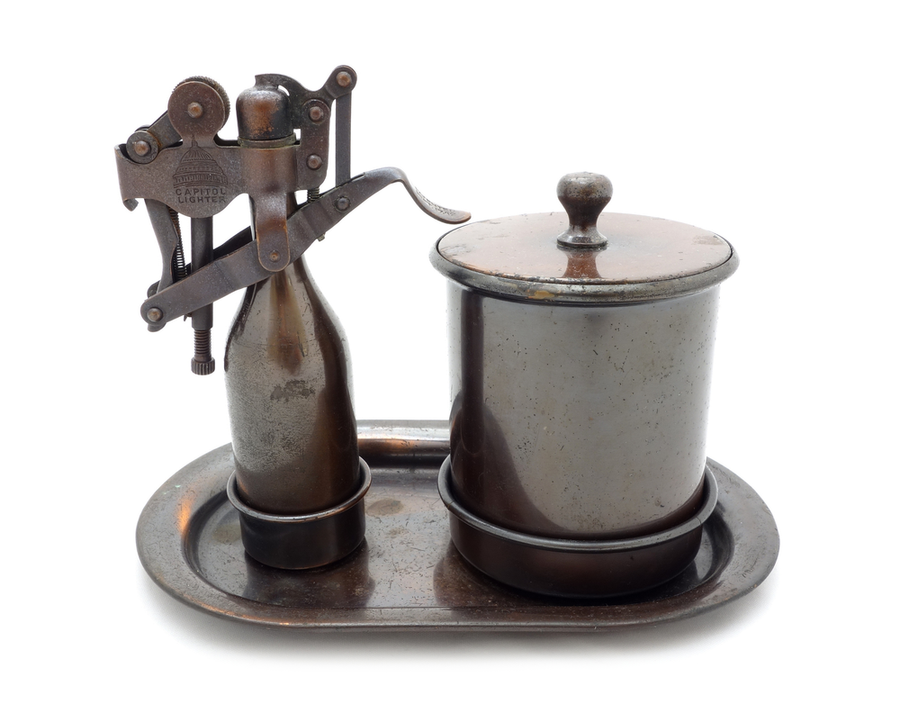
The pyrophoric lighter designed by Josef Kluss in Wien and patented in Austria in 1925 was used by Steele & Johnson of Waterbury to produce the Capitol Lighter which was a success in the US.
The Capitol Lighter was manufactured between 1927 and 1931 by Steele and Johnson in Waterbury (Connecticut) in the United States of America. The company was founded in Waterbury in 1851 and manufactured brass and other metal goods. The firm opened a New York shop in 1865 and ceased operation in 1933.
This unusual brass/bronze table lighter features a mechanical snap up levered mechanism. The mechanism as well the design of the lighter were invented and patented on the 10th of March 1925 (patent no. AT99438) by Josef Kluss of Vienna in Austria. The fact that Steele & Johnson Mfg. Co. used the patent filled by George S. Eldred on 17th September 1912 in the USA (patent no. US1038735) is unfounded as it features a absolutely different mechanism (semi-automatic).
This automatic petrol lighter is one of the most desired lighters by collectors because of the fairly complicated and interesting mechanism. The Capitol Lighter was manufactured in many different configurations (lighter with ashtray – both table and floor, lighter with a tray and cigarette holder etc.). Also the choice of finishes was quite impressive: plain brass, bronze, nickel plate and painted in three basic colors: red, green and yellow which was the most common one).
There are two main version of the Capitol Lighter. The earlier one manufactured between 1927–1928 is a direct copy of the Josef Kluss design in which the thumb lever of the lighter is straight and marked PATENT APL FOR. The second version (see pictures) has a curved thumb lever and was marked PATENTED SEPT. 17, '12. For filling the lighter mechanism is removed from the top of the bottle. On the earlier version of the Capitol lighter a circle label on the bottom says:
Matchless Utilities Co. 690 8. Ave. New York Classic Gas & Cigar Lighters Telephone Lackwanna 8855
and the younger version:
Steele & Johnson Mfg. Co. Waterbury Conn.
New York Office 290 Madison Ave.
The lighter was also manufactured for Gerlach Barklow Co. which was one of the largest calendar and advertising companies in America. It was marked "G.B. Co. Joliet ILL." rather then "Capitol Lighter".
Type: petrol (wick) lighter
Scarcity: uncommon to very rare (depends on version)
Value for good–mint condition: $100.00–400.00 (approx €75.00–300.00)
A black&white magazine advertisement published in The American Magazine on November 1929. It depicts the Ronson De-Light Series including the table lighter Ronson Tabourette.
It is not the most expensive table lighter in the world but for sure a very unusual one. It was sold yesterday on eBay.
The opening bid started at $25 on June 8th 2013. Seven days later
this rare Dunhill table lighter had received 33 bids from 15 bidders. The seller described it as being in overall very good condition.
This lift-arm table lighter was manufactured by Dunhill (model Unique) in the late 1920's. It is marked STERLING, GERMANY and DUNHILL NEW YORK along with three silver hallmarks. Lighter stands about 2-38" tall. It is about 2.25" wide and 1.25" thick at the base. The lighter is made of sterling silver and has a beautiful enamel painting of birds in flight at the edge of a lake. Below some more pictures of this lighter:




67Q~~60_57.JPG)
!mQ~~60_57.JPG)


