Sunday, February 28, 2010

M.T.C. Chromium Swan, 1960


This table lighter in a distinguished form of a young swan was manufactured in the beginning of the 1960s by M.T.C. in Japan. M.T.C. was a quite successful Japanese company active in the 50's and 60's. There are a lot of interesting examples of the craftsmanship of M.T.C. Looking around the lighter market M.T.C. produced mainly chrome plate cigarette lighters.

The Swan is made of heavy chrome plate and the lighter insert is not removable.

The letters M.T.C. are inscribed in a bell on the bottom of the lighter base.

Type: petrol (wick) lighter

Scarcity: uncommon

Value for very good–mint condition: $20.00–40.00 (approx €15.00–25.00)

Weight: 205 grams (0,57 pounds)

Dimensions:
  • height: 7.5 cm (3")
  • width: 3.9 cm (1.5")
  • length: 8.5 cm (3.5")

Tuesday, February 23, 2010

MaruMan T2 Electric, 1970


The MaruMan T2 Electric Table Lighter was marketed in the 1970 in Japan. It is one of the most interesting examples of the evolution of piezoelectric technology fitted in MaruMan table lighters. The first Maruman piezoelectric table lighter was introduced in 1967 and simply called "Business Lighter". It was three years after (December 1964) Mansei Koyo Kabushiki Kaisa of the MaruMan company produced the first piezo lighter in the world.

This unique table lighter is made of various materials: brass with gold plating, black and white plastic and of course the heavy hand-cut leadcrystal. The mechanism of the lighter is very simple though still sophisticated: when the white button is pressed the lighter lits and also a lamp build into the crystal turns red. When the button is released  the lamp turns blue. When the button is pressed again both the light and lighter are switched off.

On the lead crystal is a sticker saying:
Imported 
Leadcrystal
Hand cut


The flame control, filling hole and the battery compartment are situated in the plastic base which is padded with green felt. It is also marked:

ELECTRIC TABLE GAS LIGHTER
T2
MaruMan
PAT.

Very similar lighters were manufactured also by another Japanese company called "Modern", for example its model "Gloria".

Type: electric gas (butane) lighter 

Scarcity: rare

Value for very goodmint condition: $80.00–120.00 (approx €60.00–90.00)

Weight: 810 grams (1.79 pounds) - without batteries

Dimensions:
  • height: 17.0 cm (6.7")
  • diameter: 10.9 cm (4.3")

Monday, January 25, 2010

Zippo Moderne, 1960

The Zippo Moderne Table Lighter was first manufactured in 1960, next to the Zippo Corinthian desk-top lighter, in Bradford, Pennsylvania in the United States. Both the Moderne and Corinthian were discontinued in 1966 though they were marketed till 1967. It is worth to mention that in this period Zippo marketed three different models of table lighters: Zippo Moderne, Zippo Corinthian and Zippo Barcroft.

The Zippo Moderne was available in three finishes:
  • black and rhodium (no. 1310), 
  • bright rhodium (no. 1315),
  • satin rhodium (no. 1320). 
All three were selling for the same price of $12.50. It might be interesting to know that during the time of production the Zippo Moderne has changed a little bit. The face lifting was connected with rounding the edge of the pedestal which was till 1963 more sharp.

The slim removable lighter insert unit was also used in the Zippo Corinthian. The base is padded with black felt and marked: ZIPPO (R). The Zippo lighter insert is also marked: 

ZIPPO MFG. CO. BRADFORD, PA.
MADE IN ZIPPO U.S.A.
PAT. 2517191 (R) PAT. PENDING

or (later version)

ZIPPO MFG. CO. BRADFORD, PA.
MADE IN ZIPPO U.S.A.
PAT. 2517191 (R) PAT. 2940286

Type: wick (petrol) lighter 

Scarcity: rare

Value for goodmint condition: $100.00–150.00 (approx €70.00–100.00)

Weight: 240 grams (0.53 pounds)

Dimensions:

  • height: 12.5 cm (4.9")
  • diameter: 5.8 cm (2.3")

Saturday, January 16, 2010

Zippo Corinthian Table Lighter, 1960


The Zippo Corinthian Table Lighter was first manufactured in 1960 next to the Zippo Moderne desk-top lighter in Bradford, Pennsylvania in the United States. Both the Moderne and Corinthian were discontinued in 1966 though they were marketed till 1967. This is the best looking table lighter produced so far by Zippo. It has a delicate shape of an urn which makes it quite handy. The Zippo Corinthian was available in three finishes:
  • bright rhodium (no. 1710), 
  • turquoise and rhodium (no. 1715),
  • pearlescent rhodium (no. 1720). 

All were selling for the same price of $16.50 but only two had a delicate high-fired enamel (in turquoise and pearlescent color). The 1960s were the only period in the history when Zippo marketed three different models of table lighters (see picture on the left: Zippo Moderne, Zippo Corinthian and Zippo Barcroft).

The slim lighter insert is removable and was also used in the Zippo Moderne. The base of the lighter is padded with black felt and marked: ZIPPO (R). The Zippo lighter insert is also marked: 

ZIPPO MFG. CO. BRADFORD, PA.
MADE IN ZIPPO U.S.A.
PAT. 2517191 (R)

Type: wick (petrol) lighter 

Scarcity: uncommon-rare


Value for very goodmint condition: $100.00–160.00 (approx €85.00–140.00)

Weight: 220 grams (0.49 pounds)

Dimensions:

  • height: 10.5 cm (4.0")
  • diameter: 5.9 cm (2.3")

Sunday, January 10, 2010

Dunhill Sabre Jet Fighter, 1954


The Dunhill 'Jet Plane' Lighter is depicting the famous North American Aviation F-86 Sabre a transonic jet fighter aircraft. The  Sabrejet set its first official world speed record of 570 mph (920 km/h) in September 1948. Six years later in 1954 in England this heavy Dunhill figural lighter was manufactured. The production ceased in 1961.

The table lighter was available in polished chrome and also black lacquered.  It ignites automatically when the button in the engine intake at the front is pushed – then the canopy opens and exposes the flame. Very efficient and solid mechanism – works at every single try. The base is padded with green felt. Below a drawing of the Sabre F-86.


The Dunhill Sabre Jet is also known under other names like: Dunhill Jet Plane Lighter or Dunhill Airplane (Aeroplane) Table Lighter or just Dunhill Jet Fighter.

Type: petrol (wick) lighter

Marked on the underside of the base:
dunhill
REG. DES. APPL. NO. 872899
MADE IN ENGLAND

Scarcity: rare

Value for good–mint condition: $240.00–450.00 (approx €115.00–350.00)

Weight: 580 grams (1,28 pounds)

Dimensions:
  • height: 8.3 cm (3.3")
  • width: 14.9 cm (5.9")
  • length: 16.1 cm (6.3")

Sunday, January 3, 2010

Zippo Barcroft No. 4, 1953


The Zippo Barcroft is the proud successor of the Zippo #10 which was produced till 1953. The Zippo Barcroft was manufactured between 1953 and 1979 in Bradford, United States and also in Canada. One often refers to it as the 4th edition or version of the Barcroft Table Lighter which is a simple combination of a traditional Zippo lighter insert and an attachable pedestal base. It was made in various finishes like: brass, polished chrome and the most popular steel satin finish.

This Zippo table lighter was often used as a promotional gadget for different organizations and occasions. In many cases a logo of a very known brand on the Barcroft will add value to it. For example a Barcroft with a Coca Cola logo might cost above $600. Other less valuable examples are: USS (United States Steel), Chrysler or Ford.

The lighter insert can be removed from the pedestal and used as a normal Zippo pocket lighter. The base is padded with black felt. The Zippo lighter insert is marked:


ZIPPO MFG. CO. BRADFORD, PA.
MADE IN ZIPPO U.S.A.
PAT. 2517191 (R)

Type: wick (petrol) lighter

Scarcity: uncommon

Value for goodmint condition: $90.00–140.00 (approx €60.00–100.00)

Weight: 308 grams (0.68 pounds)

Dimensions:
  • height: 8.4 cm (3.3")
  • width: 5.5 cm (2.2")
  • depth: 4.1 cm (1.6")

Friday, November 20, 2009

Ronson American Classic Table Lighter, modern example


The Ronson 'American Classic' Table Lighter is a modern example of the table lighters manufactured these days. It was manufactured between the year 2001 and 2003 in China and distributed mainly by Ronson in Italy and the USA. This table lighter has a bronze antique finish with a floral pattern. The base is padded with black velvet.

The removable lighter insert the Ronson Whale is the successor of the  Ronson Varaflame Windmaster which was also equipped with a wind housing. This butane lighter insert has a typical flint ignition and the flame can be controlled. Only the lighter insert is marked: RONSON Whale

Type: butane (gas) lighter

Scarcity: uncommon

Value for mint condition: $45.00 (approx €30.00)

Weight: 395 grams (0,87 pounds)

Dimensions:
  • height: 8.6 cm (3.4")
  • width: 7.1 cm (2.8")
  • depth: 5.5 cm (2.2")

Wednesday, November 18, 2009

Hamilton Ship Wheel Table Lighter, 1940


This Ship's Wheel Table Lighter made by Hamilton was first manufactured in 1940 in the United States. This nautical figural lighter is heavy chrome plated (no. 3QR7561B) - likely the other most famous Hamilton products: the Airplane and the Knight Table Lighter. The top as well the bottom are painted in black. It was though also available in brass finish (no. 3QR7562C) which is rare.

The wick lighter lights by turning the wheel. The lighter is marked on the underside of the base:

MADE IN U.S.A.
PAT PEND.

or 
 

MADE IN U.S.A.
A PRODUCT OF HAMILTON
PAT PEND.

A magazine advertisement from the 1940 says: Marine Style-Turn the Wheel-Lights Up. Here's just the right nautical touch for desk, smoking stand or den-a ship's wheel lighter that never misses. Just turn the wheel and it lights up with a steady lighthouse flame. Designed with all the smooth trimness of true marine engineering and finished in brilliant chromium or brass that will not tarnish or stain. Holds oceans of fluid so that it will go week after week without being refilled, lighting up faithfully at the flick of a finger. Lighter stands 5 inches in height.

A similar lighter design was used by Dunhill and it is rare. It fetches prices above $250.-.

Type: wick (petrol) lighter

Scarcity: uncommonrare

Value for good–mint condition: $75.00–100.00 (approx €50.00–65.00)

Weight: 330 grams (0,73 pounds)

Dimensions:
  • height: 12.9 cm (3.0")
  • diameter: 7.3 cm (2.5")

Wednesday, November 4, 2009

A.S.R. Classic Table Lighter, 1949


The 'Classic' (model no. 1250 T) was manufactured in 1949 by the American Safety Razor Co. in the United States (Brooklyn, New York).  This model was available only in gleaming rhodium finish.

The look of the table lighter refers to the Arts and Crafts Movement. The A·S·R 'Classic' was marketed in a silver presentation box. The base of the lighter is padded with green felt. It is marked on the base:


A·S·R
(R)
LIGHTER

The lighter insert has an automatic 'Light-Switch Action' and stays lit without holding. It is marked:

A·S·R CORP.
315 JAY ST.
BROOKLYN, N.Y.
PATENT D-146973

PAT. APP. FOR
MADE IN U.S.A.

One of the advertisement published in the "Life" magazine in 1949 says about this product: "A·S·R 'Classic' Table Lighter in luxurious Rhodium finish. Won't tarnish, can be machine engraved. Great fuel capacity and all other distinctive A·S·R features."

Scarcity: uncommon

Value for very good–mint condition: $40.00–60.00 (approx €30.00–45.00)

Weight: 290 grams (0,64 pounds)

Dimensions:

  • length: 7.9 cm (3.11")
  • width: 4.4 cm (1.73")
  • height: 6.6 cm (2.6")

Wednesday, September 30, 2009

Ronson Leona Table Lighter, 1949


The Ronson Leona was first manufactured in 1949 in Newark, New Jersey, USA. The production ceased in ca. 1955. According to U. Cummings the lighter was named after Leona Aronson who was the wife of Alexander H. Aronson the son of  Louis V. Ronson - the founder of the Ronson Corporation.

A quite successful model marketed in many various finishes. The body of the lighter was available in Venetian bronze plate or silver plate. The enameled center section was even more diverse:
  • green enamel (common),
  • ivory enamel with red flowers pattern (common),
  • black enamel with purple flower pattern (rare),
  • black enamel - plane (uncommon)
  • corn flower blue enamel (uncommon),
  • rose (pink) enamel (uncommon).
The lower section of this table lighter is finished with a delicate ivy, berries and swirl pattern. The Ronson Leon has a Standard Ronson lighter fitment. The bottom of the base is padded with green felt. It is marked:


RONSON (R)
NEWARK, N.J. U.S.A.
U.S. PATENT PE.NO. 19,023
CANADA PATS. -288,148-289,889 
(R)
RONSON
"LEONA"

or

RONSON (R)
MADE IN ENGLAND
BRIT PAT 621570
RONSON
"LEONA"

Type: petrol (wick) lighter

Scarcity: uncommonrare

Value for very good–mint condition: $35.00–100.00 (approx €25.00–70.00)

Weight: 227 grams (0.5 pounds)

Dimensions:
  • height: 7.3 cm (2.88")
  • width: 5.4 cm (2.13")
  • depth: 3.8 cm (1.5")

Dunhill Aladdin's Lamp, 1952


The Dunhill Aladdin's Lamp (also known as the Roman Lamp) lighter was manufactured between 1952 and 1960 in England. It is also known as the Roman Lamp. This solid vintage petrol table lighter was manufactured in three different finishes – polished chrome, silver plate and antique copper finish. The picture below presents the Aladdin's Lamp in antique brass finish.


The lighter has a very precise trigger activated mechanism - the top opens and sparks when the trigger is pulled. Very efficient mechanism – works at every single try. The base is padded with green felt.

This table lighter was advertised by Dunhill as: An ingenious adaptation of the Ancient "Lucerna" - The Roman Lamp of Imperial Times - to the modern purpose of a Dunhill Lighter.

Type: petrol (wick) lighter

Writing on the underside:
dunhill
PROV. PAT. NO. 32981/49.
REG. DES. APPL. NO. 861972
MADE IN ENGLAND

Scarcity: very rare

Value for very good–mint condition (dependent on finish) : $200.00–450.00 (approx €135.00–300.00)

Weight: 432 grams (0,67 pounds)

Dimensions:
  • height: 12.8 cm (5.04")
  • length: 17.0 cm (6.7")
  • depth: 7.0 cm (2.8")

Ronson Varaflame Luralite, 1967


The Varaflame Luralite is one of the 25 different table lighter models of Ronson produced in the second half of the 1960s. This particular butane lighter model was manufactured in Woodbridge in New Jersey (U.S.A.) between 1967 and 1971. The Varaflame Luralite was available in three finishes: gold, anthracite and silver tone (see picture). The surface of the base of the lighter has a patched pattern.

The removable lighter insert the Varaflame is in case of the silver tone finish chrome-plated  with some gold color elements; the other two are fully gold color plated. The fingertip flame control is decorated with a light blue Swarovski crystal. The base is padded with cork. A silver label should also be on the underside of the base with  few text lines, among others:


"VARAFLAME (R) Luralite"
fashioned by RONSON (R)
WOODBRIDGE, N.J. U.S.A.
...

Type: butane (gas) lighter

Scarcity: common

Value for very good–mint condition: $25.00–35.00 (approx €20.00–30.00)

Weight: 290 grams (0,64 pounds)

Dimensions:
  • height: 7.6 cm (3.0")
  • diameter: 6.35 cm (2.5")

Dunhill Sylph Ruler, 1954


The Dunhill Sylph Ruler was manufactured between 1954 and 1961 in England. In 1955 the name of the lighter was changed to 'Sylph Rulerlite'. This lighter is in the shape of a ruler which is marked both with centimeters and inches. It was produced in two finishes: silver plate and solid silver (sterling). In addition a version with a paper cutter at the end was also marketed in the late 1950s.


Marked on the bottom of the base:

SYLPH
dunhill

In the Dunhill catalog from the 1959/1960 the rulerlite was advertised as: A useful, dual-purpose gift, suitable for desk or pocket. Calibrated in inches centimetres.

Type: petrol (wick) lighter

Scarcity: rare

Value for good–mint condition (depends on finish): $200.00–550.00 (approx €140.00–370.00)

Weight: 190 grams (0,35 pounds)

Dimensions:
  • height: 1.0 cm (0.4")
  • width: 2.0 cm (0.8")
  • length: 16.0 cm (6.3")

Tuesday, September 15, 2009

Zippo Handilite, 1979


The Zippo Handylite was introduced in 1979. It was manufactured in various finishes till 1999 in Bradford, United States. This table lighter is a simple combination of a traditional Zippo pocket lighter and an attachable pedestal base.

It was available among others in (see picture below):
  • Brush Chrome, no. 200H,
  • High Polish Gold Electroplate, no. 250GH,
  • Regular Black Matte with Horse, no. 218H-HG,
  • High Polish Gold Electroplate with Bighorn Sheep (Ram), no. 250GH-RM,
  • High Polish Gold Electroplate with Snoozin' Camel.


The lighter can be removed from the pedestal (which could be purchased separately) and used as a normal Zippo pocket lighter. Most regular size Zippo lighters are adaptable to Handilite. The lighter base is padded with black felt and it is marked:  

ZIPPO (R) 
Bradford, PA USA

See also the Zippo Handilite magazine advertisement.

Type: wick (petrol) lighter

Scarcity: uncommon

Value for good-mint condition: $34.00–125.00 (approx €60.00–65.00)

Weight: 200 grams (0.44 pounds)

Dimensions:
  • height: 9.1 cm (3.6")
  • diameter: 3.8 cm (1.5")

Ronson Waldorf, 1936


The Ronson Waldorf was first manufactured in 1936 in Newark, N.J., USA. There are two versions of this table lighter. The first was produced between 1936–1937 and the second, which is less scarce, between 1950–1952 (see picture). Both versions used the Ronson Adonis fitment.

This wick lighter is quite heavy – it is made of "white metal" which is silver-plated. The base is padded with green felt. The lighter base has an oval shape and its leitmotiv is a band of leaves.

The second version of the Waldorf was sold alone and in a set consisting of a matching tray and cigarette holder.

Marked on the bottom of the base:

RONSON (R)
NEWARK, N.J. U.S.A.
U.S. PATENT RE. NO. 19023
CANADA PATS.-288.148-289.889
RONSON
"WALDORF"
TRADE MARK

Type: petrol (wick) lighter
Scarcity: rare

Value for good–mint condition: $55.00–100.00 (approx €40.00–70.00)

Weight: 330 grams (0,73 pounds)

Dimensions:
  • height: 6.5 cm (2.6")
  • width: 4.8 cm (1.9")
  • length: 7.8 cm (3.1")

Friday, September 11, 2009

Zippo Lady Barbara, Classic Antique 1997


The Zippo Lady Barbara was first released as a 65th Anniversary model lighter in 1997 - it had an etched 65th Anniversary logo on the front (see picture). Lady Barbara was manufactured in three different finishes till 2003 in Bradford, United States. The Lady Barbara Classic Antique has a silver plate antique finish and was manufactured between 1998-2003 and it replicated the classic 1949-51 Zippo Lady Bradford design. Beside the Anniversary model and the Classic Antique model there is a Camel model with a etched Camel logo on the front.

This modern antiqued silver plate lighter can be removed from the Lady Barbara pewter base and used as a normal Zippo pocket lighter. The base is padded with black felt and it is marked: ZIPPO (R) Bradford, PA USA.

This Zippo might be a classic though it looks awkward and feels quite cheap.

Type: wick (petrol) lighter

Scarcity: common

Value for mint condition: $90.00–100.00 (approx €60.00–65.00)

Weight: 276 grams (0.61 pounds)

Dimensions:
  • height: 8.2 cm (3.23")
  • width: 5.2 cm (2.05")
  • depth: 2.7 cm (1.06")
Below the product page of the 65th Anniversary Zippo Table Lighter from the German Zippo Collection Catalog 1997/1998 Classics/Selects.


Tuesday, September 8, 2009

Speculation and long-term investment in vintage cigarette lighters


Lighters collectors are usually both buyers and sellers. Some of them collect lighters because of self-actualization, some of them think about their grandchildren and others perceive it as an investment or just as a alternative for paper money. Investing as well as speculation requires knowledge, luck and taste. It refers also to vintage cigarette lighters. You probably won't be a millionaire though you can benefit on your unique knowledge on lighters. How? What kind of profit do we talk about?

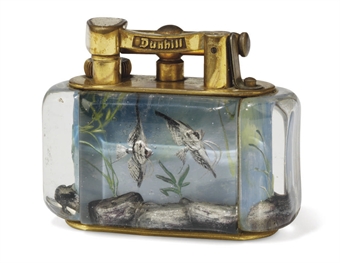
Let's consider you have bought a Dunhill ‘Aquarium’ lighter on a garage sale for $20 in excellent condition five years ago. The previous owners did not know that this table lighter was something special - they even did not know where to find any information about it. It would help to know that this lighter was manufactured in relatively small amounts in England in the 1950's and that it was hand-painted by Ben Shillingford.


So you have made a fantastic deal from todays perspective. Such bargains happen also today though the future will change it. The main reason for it is the wide-spreading Internet and easy accessible sources on vintage lighters. Additionally there number of people who find collecting lighters amusing rises. The limited supply and rising demand causes that the prices of particular examples of lighters will go up.

Going back to our story, three years ago you decided to sell it on ebay as the prices for it was astonishing high - average price for it (excellent condition) was at $1700-1900. You sold it though you still have monitored the market for the Aquarium Dunhills just for curiosity. You are not happy anymore, because since than the dissonance of your decision rose. Why? Because the price you could get was also rising and now you would get for it more than $3300. There are more examples of lighters that experienced such astonishing value appreciation.

The highest increase of value can be registered particularly in some luxury niche brands like Dunhill or DuPont. The time will probably also come to some lighters from more popular brands like Evans, like the Phinney Walker Evans lighter alarm clock. To a higher demand for particular lighters do contribute museums, galleries, antique guides, cigarette lighter books, movies etc. The more a lighter is showed, described, admired the higher value might can expect...


Saturday, September 5, 2009

How much is my vintage cigarette lighter worth?


General speaking, the value of a lighter can be identified with the price someone is ready to pay for it. This thesis would be correct if only the market would be perfect (perfect information and perfect competition). Of course it is not. That is why collectors search for a better way of valuating their trophies. The simplest way is to look for the most up-to-date reference sources, like ended auctions or on-line guides.

Estimating the value of vintage lighters is a very complex process. One need to take into account several factors. The collectors value depends on:

1. Condition

The condition is one of the most fundamental issue for a collector. The most sought after are lighters in mint, pristine condition. The poorer the condition the less valuable is a lighter. It is often the case that the difference in pricing between a lighter in good condition and mint condition is 45-75%. It is worth to now that a mint cigarette lighter should include packaging, instructions, tags etc. To such lighters one refers to as "old new stock" (abbreviated ONS) or "mint in box" (abbreviated MIB).

2. Age

In general, the older the lighter is the better. The main reason for it is scarcity and condition. It is much easier to find a Ronson Crown manufactured in 1952 than a Ronson Crown in the 1936 in excellent or mint condition. Furthermore the closer we are of the modern times the closer the mass production economy model.

3. Brand, model, country, style of origin etc.

People collect everything. I am quite sure it would be impossible to find anything that comes to your mind that people do not collect. The only issue is many of them collects what. Regarding vintage cigarette lighters, collectors often specialize in collecting lighters that can be ascribed to a distinct category, like: German lighters, pocket lighters, figural lighters, lighters made by Evans, lighters made of silver, Art Deco lighters, wick table lighters, etc. The price of a lighter will than depend on the amount of collectors of its kind and fashions. Of course not only lighter collectors look for vintage lighters. You should take into consideration for instance people who are decorating their homes in one particular style, like Art Nouveau - they also will look for lighters in Art Nouveau style.

4. Scarcity

The most important factor for scarcity is the amount of lighters that were manufactured. One can also include the problem of wars in which a lot of goods is being destroyed, etc.

5. Quality and materials used for production

It is quite obvious that a lighter made of gold is more valuable than the one made of silver. The same counts to fine craftsmanship.

OK, are that all factors? Of course not, but these are the most important factors that must be considered in you estimation.

The nominal value of a lighter

Due to inflation the real value of money decreases. It refers to all currencies whether it is a dollar, euro or pound. In opposite to paper money gold does not lose its value due inflation. That is why it is the best mean in the analysis to compare prices and the purchase power of money long term. The nominal value often differs from the real market (collectors) value.

Zippo case study: The market value for a Lady Bradford Zippo table lighter in 1950 (see advertisement from Life magazine from 06.05.1950) was $10. Actualizing the $10 price tag the nominal value today should be much higher. One once of gold in 1950 cost $40,25 and in 2008 it was near $872. It means in 1950 you could buy for one once of gold only 4 Lady Bradford Zippos! In terms of nominal value the very same Lady Bradford would cost today $218. But it does not - you can have it in mint condition at ebay for approx. $150. Can someone explain why? What happened here? What has changed in these years?

PS. The Zippo Lady Bradford was manufactured between 1949-1951. In addition Zippo started in 1997 (production ceased in 2002) a reissue of the classic Lady Bradford calling it Lady Barbara. It is still available for approx. $100.
PS2. The yearly gold prices since 1793 can be found here.

Monday, August 31, 2009

Hy Glo & Frank M. Whiting, Crown, ca. 1932


The Hy Glo & Frank M. Whiting lighter was made in the early 1930s. Hy Glo Products Co. Owosso, Michigan U.S.A. provided only the small sterling wick lighter insert marked: Hy Glo MADE IN U.S.A. Hy Glo went out of the lighter business in 1949 due to a fire that destroyed the whole factory complex.

The lighter was sold alone - without a matching ashtray or cigarette urn like the older brother. The lighter is made of glass and silver sterling (925). The lighter has a relatively heavy removable cap (top cover) made from an alloy and silver-plated

Worth to know is that the Frank M. Whiting was founded in 1878 in North Attleboro, Massachusetts by the son of William Whiting, the founder of the Whiting Manufacturing. In 1895, the company was converted to a stock company under the name F. M. WHITING & Co. In 1896, the firm's name was changed to FRANK. M. WHITING & Co. In 1897 the company was incorporated and later in the 1924 was purchased by the Elmore Silver Company of Meriden, CT. Their line included sterling silver flatware, hollowware, novelties, souvenir spoons, etc. The brand was on the market till 1940.

Marked on the silver:

FRANK M. WHITING & CO.
STERLING

Type: petrol (wick) lighter

Scarcity: uncommon

Value for good–mint condition: $40.00–70.00 (approx €30.00–50.00)

Weight: 162 grams (0.36)

Dimensions:
  • height: 6.2 cm (2.4")
  • diameter: 5.8 cm (2.3")

T. Kullander & Evans Table Lighter, 1954


This extremely rare table lighter was manufactured by KULLANDER SILVERSMEDEN TORE in 1954 in BORĹS, Sweden. The company prospered from 1938 to 1976. It manufactured sterling and silver-plated flatware and hollowware mainly for the Swedish market.The base of the lighter is made of silver – probably 830 grade of silver. It is weighted and marked. The lighter has a round base and feels very robust.

The
lighter insert was provided by Evans (USA). It is made of brass and is silver electroplated.

Type:
petrol (wick) lighter

Marked on the bottom:

Scarcity: extremely rare


Value for very good–mint condition: $250.00–400.00 (€175–280)

Weight:
260 grams (0,57 pounds)

Dimensions:

  • height: 9.3 cm (3.66")
  • diameter: 6.3 cm (2.5")